Commercial Loans Canberra
We source finance for your business off your financials rather than a payslip: premises, working capital or equipment, matched to lenders whose appetite fits your industry and your security. Commercial loans Canberra businesses take on need a larger deposit and a shorter term than a home loan. It costs you nothing to have us tell you what that means before you commit, because the lender that writes the facility pays us.
65 to 80% of value
The usual commercial range, below what residential lending allows. The assessment runs on the business figures and the strength of any lease, not on a payslip.
Lender policy, current at August 2026
What We Source For A Business
Three things sit under this heading and lenders assess them differently: a loan against commercial premises you occupy or let out, general business lending for working capital or an acquisition, and finance secured against a vehicle or a piece of plant. Most Canberra businesses come to us for one of the three and end up needing to weigh two.
One thing you should know at the outset. Most commercial lending sits outside the consumer protections of the National Credit Code, so the disclosure regime that covers a home loan does not apply to you here in the same way. Where your loan is genuinely for business purposes, the lender assesses and documents it on a commercial footing. Where your proposal mixes business and personal borrowing, the position turns on the predominant purpose, and we will tell you which regime applies to your specific structure rather than leaving you to assume.
What A Lender Will Want From Your Business
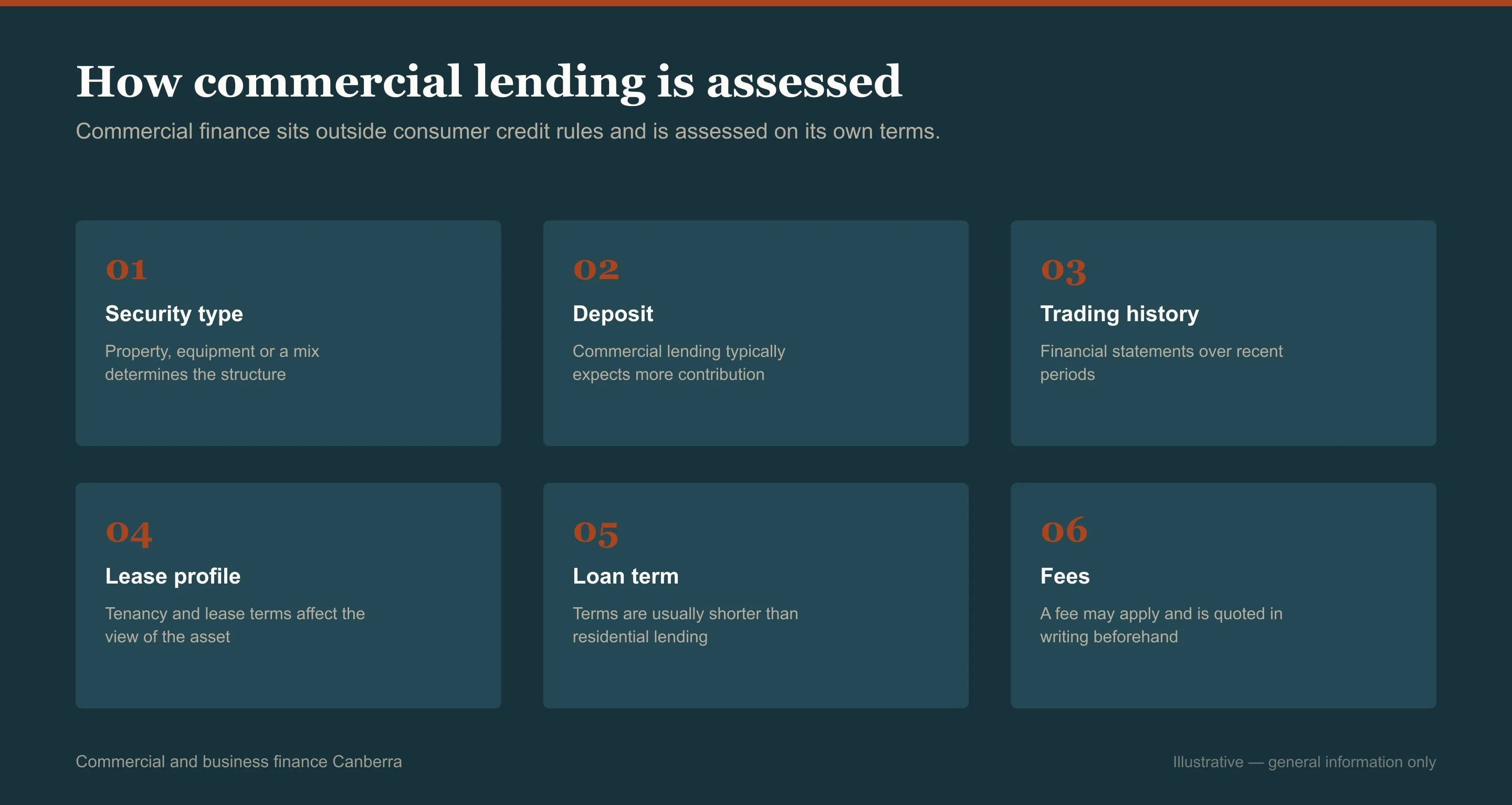
The first difference you will feel is the ratio. Commercial lending generally runs at 65% to 80% of the security value against up to 80% or higher on residential, so your deposit is larger from the outset. We would rather size that for you now than after you have made an offer on premises.
A lender assesses you on your business rather than your income: two or three years of financial statements, tax returns, and the trading history behind them. Lenders look at your earnings, the trend, your industry, and how concentrated your revenue is. One large customer reads as riskier than the same revenue spread across twenty, which matters to a good number of Canberra businesses working on government contracts. Where that concentration is your position, we take you to the lenders that understand the sector rather than ones that will simply mark you down for it.
Your term will be shorter than a residential one, commonly with a review or rollover date rather than a straight thirty years. That is normal, but it means your facility is reassessed periodically rather than running untouched to the end, and if your figures have deteriorated by then the terms can change. We factor that review date into what we recommend, because a sharp rate on a facility you cannot refinance at review is not a good outcome for you.
If You Are Weighing Buying Canberra Premises Against Leasing
When you buy as an owner-occupier, lenders take some comfort from the fact that you are the tenant. There is no vacancy risk and no question about the lease covenant, because it is you. That generally works in your favour on both ratio and price.
If you are buying as an investment with a tenant already in place, the lease becomes central to how the lender assesses you: a long lease to a strong tenant supports a better outcome than a short lease to a small one, and a vacant Canberra property is the hardest of the three to fund. The lease decides which lenders are worth approaching, so it is the first thing we read.
Whether to buy or keep leasing is your business decision rather than a lending one, but we will price the finance so you are comparing real numbers instead of estimates. The figure we make sure you have weighed is the deposit. Capital that goes into premises is capital no longer available as working capital, and for a growing business that trade-off usually matters more than the monthly comparison suggests.
Which Of The Two You Actually Need
Two separate needs that often arrive together for a Canberra business, and we will tell you which one fits the purchase in front of you.
Business lending
Working capital, an overdraft, or funding for an acquisition or expansion. A commercial lender assesses you on your trading figures, and you will generally have to offer security: commonly property, sometimes a general security agreement over your business assets. Unsecured business lending exists, but it is priced accordingly and sized conservatively, so we treat it as a last resort for you rather than a starting point.
Equipment and asset finance
Vehicles, plant and equipment, usually secured against the asset you are buying. It is often faster and simpler for you than a general business loan because the security is specific and easily valued, and it keeps the borrowing off your property. Where you are about to draw on an overdraft for a piece of equipment, tell us first. This is almost always the cheaper route.
Before You Put Your Home Behind The Business
Lenders will often accept your Canberra home as security for business borrowing, and it usually produces a better ratio and a sharper rate than commercial security does. That is why it gets suggested to you.
The risk is exactly what it looks like: if the business fails, your home is part of the security the lender can pursue. Keeping them apart costs you something in rate and ratio, and we will quantify that for you so it is a decision you make deliberately rather than one that happens by default.
Where you do use the home, we structure the business borrowing as a separate facility rather than merging it into your home loan. That keeps your position clear and makes it far easier to have the residential security released later. And because a loan that crosses between business and consumer purposes is governed by whichever purpose predominates, we establish that with you at the start rather than letting you assume it.
What We Check Before Approaching A Commercial Lender
These are the factors that decide both your ratio and your price on a Canberra commercial loan, so we work through them with you before anything is lodged.
- What you are offering as security
- Residential security gets you the best terms, standard commercial property next, specialised property the hardest, and vacant land is the most difficult of all. We match the lender to what you actually have.
- The strength of your lease
- On an investment purchase, the length of your lease and the quality of your tenant carry real weight, so we read the lease before deciding who to approach.
- How far back your figures go
- Two to three years of financials is the standard expectation. If you have less, we take you to lease-doc or low-doc options rather than letting a mainstream lender decline you.
- How concentrated your revenue is
- A lender treats dependence on one or two large customers as risk whatever your total revenue looks like, so we choose lenders that understand your sector.
- The ratio you will be held to
- Generally 65% to 80% on commercial security. That lower ratio is the main structural difference from residential lending, and it is what sets the deposit we tell you to have ready.
If Your Financials Do Not Go Back Far Enough
You may not be able to produce full financials: you have recently restructured, the entity is new, or you are buying an investment property where the rent is the real story. Lease-doc and low-doc products exist for exactly that, and we know which Canberra lenders still write them and on what terms.
A lease-doc loan assesses you primarily on the rental income from the lease rather than on your financials, which suits a Canberra investment property with a solid tenant already in place. A low-doc loan substitutes alternative evidence for full tax returns, typically your accountant’s declaration and business bank statements.
Both cost you something: a lower ratio, a higher rate, and closer scrutiny of your security. They are a legitimate route when your timing does not allow for full financials and a poor default when it does. We will tell you which of those two situations you are actually in rather than simply writing the easier application.
How We Run Your Canberra Commercial Application
Expect this to be slower than a residential file. Six to twelve weeks is common on a Canberra commercial application, the valuation is usually the longest single step, and we will tell you at the outset where your contract dates sit against that.
-
Your position and what the funds are for
What you need the funds for, how you have structured the business, and what security you have available. That decides which lenders are worth us approaching for you.
-
Your financials, read line by line
Two to three years of statements and tax returns, your current management figures, and your ATO position. Where there are gaps we tell you straight away, because they narrow your options quickly.
-
The security, and the lease behind it
What you are offering as security, and on an investment purchase, the lease and the tenant standing behind it.
-
Indicative terms before you spend anything
Commercial lenders will often give indicative terms before a formal application, and we get those in your hands before you spend anything on a valuation.
-
Valuation and formal approval
Commercial valuations take longer and cost more than residential ones, so we tell you early enough to build the time into your contract.
-
Documents through to settlement
Commercial documents are more involved than residential. We will tell you where independent legal advice is worth having, particularly where you are being asked to give guarantees.
Worth having to hand: your two most recent years of business financials and tax returns, your current management figures, details of the security you can offer, and the lease if there is a tenant in place. If you are on an ATO payment plan, say so at the first call rather than at the application, because it changes the lender list.
Commercial Loans Questions
How much can my business borrow?
It depends on the security and the financials rather than on a multiple of revenue. Commercial lending generally runs at 65% to 80% of the security value, and the assessment is built on two to three years of financial statements and tax returns. Residential security usually produces a better ratio than commercial security does. Your figures produce a real number rather than a range, which is why we start there.
What deposit do I need for a commercial property?
Typically twenty to thirty-five per cent of what the Canberra property is worth, since most commercial lending sits between 65% and 80% of value. Owner-occupier purchases sometimes achieve better terms than investment purchases, because there is no vacancy or tenant risk to assess.
Can I use my home as security for business borrowing?
Usually yes, and it often improves both the ratio and the rate, which is why it gets offered to you. What it changes is what the lender can pursue if the business fails. That is a decision worth making deliberately rather than accepting as the default, so we set out what the separation costs you in rate before you agree to it.
Do the same consumer protections apply?
Not generally. Most lending genuinely for business purposes falls outside the National Credit Code, so the consumer disclosure regime that applies to a home loan does not apply in the same way. Where a facility mixes business and personal purposes, which regime applies turns on the predominant purpose. It is worth establishing that at the start of the file.
What if I do not have two years of financials?
Lease-doc and low-doc options exist and we can take you to them. On a lease-doc loan the lender looks mainly at the rental income from the lease, which suits an investment purchase with a solid tenant. Low-doc substitutes an accountant’s declaration and business bank statements for full returns. Both mean a lower ratio and a higher rate, so they suit a timing problem rather than a permanent position, and we will tell you which of those you have.
What does it cost me to have you look at a commercial deal?
Nothing to have us assess it and come back with which lenders are realistic. On commercial and business lending the lender that writes the facility pays us, and where a particular structure would involve a fee payable by you we tell you the amount in writing before you commit to anything. You will never receive an invoice from us that you did not agree to first.
What do you need from me to look at a commercial deal?
The purpose of the funds, your business structure, what security you have available, and your two most recent years of financials with current management figures. Those four are enough to establish which lenders are realistic and roughly what terms to expect. Your ATO position matters as well, so tell us early if you are on a payment plan.
Get Indicative Terms Before You Spend Anything
The purpose, the security you have available and your most recent financials are enough for us to work out which lenders are realistic for a Canberra business like yours, the ratio and deposit you will be held to, and indicative terms where the lender will give them. All of that before you spend a dollar on a commercial valuation. It costs you nothing, and if the answer is that the numbers do not work yet, we will say so and tell you what would change it. We take commercial enquiries from anywhere in Canberra and the surrounding region.
Ask about commercial loans
Nothing here touches your credit file.