Unit and Apartment Loans Canberra
Send us the listing and the strata plan and we will tell you which lenders will finance that specific unit and at what deposit, before you offer on it. Unit and apartment loans Canberra buyers get declined on usually fail on the property rather than the income, and checking costs you nothing.
50sqm internal
The internal living area many lenders want before they will lend at 80 to 90%. Balcony and car space do not count toward it. Some accept 40sqm; below that you need a specialist.
Lender policy, current at August 2026
What We Check Before You Offer
We work out which lenders will approve the specific Canberra unit you are looking at, then prepare the application with that lender. That means checking the internal area, how the building will be classified, and whether the lender is already heavily exposed in that development.
We assess the property before we assess you, which is the reverse of a house purchase. Your borrowing capacity can be perfectly adequate and the answer still be no, because the security does not fit the lender’s policy. Establishing that before you offer is the service, and it is far cheaper than a decline after you have signed.
Why We Ask For The Strata Plan First
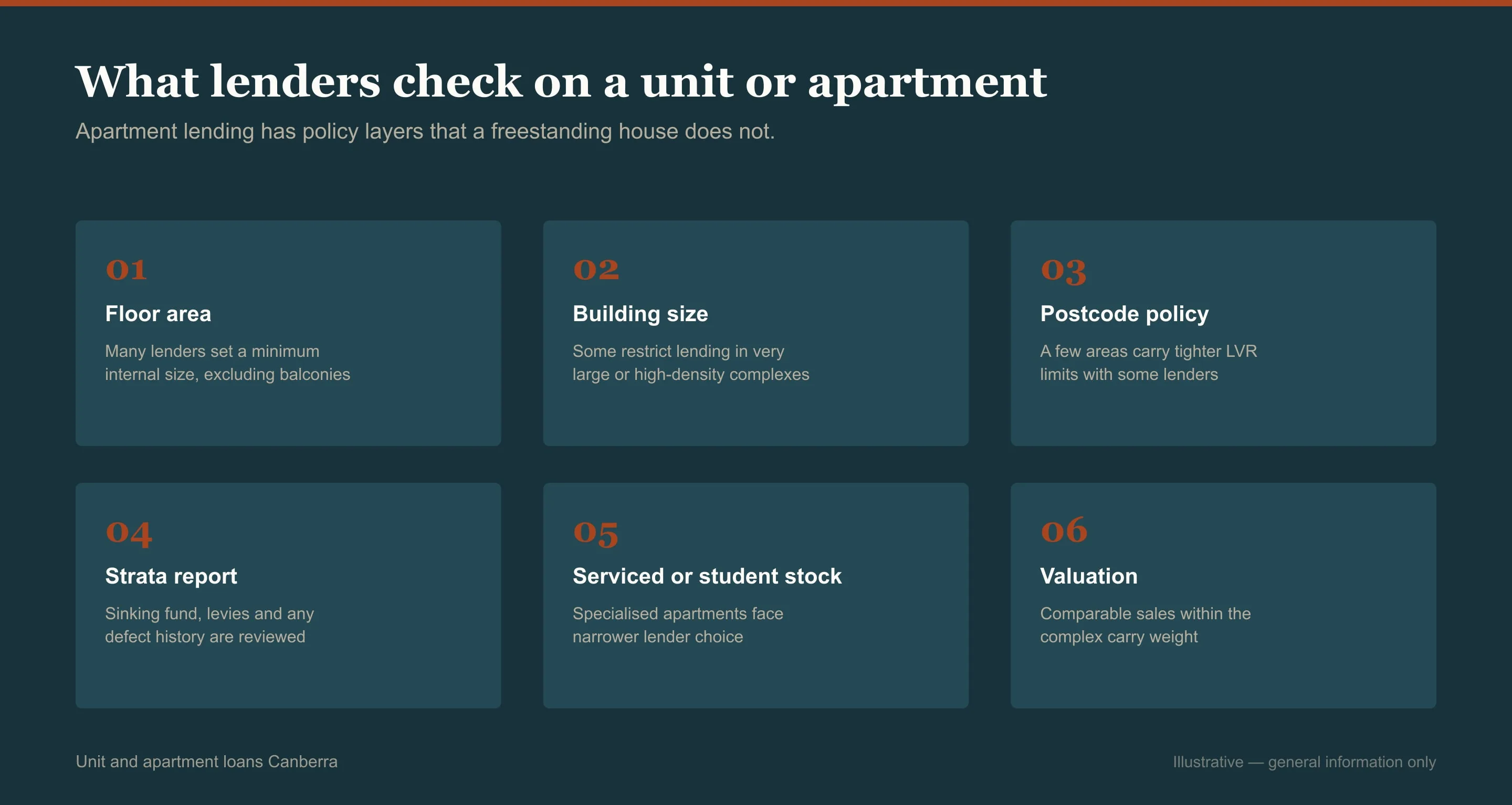
Most lenders set a minimum internal living area before they will lend at the higher ratios: around 50sqm is the common threshold for lending at 80% to 90% of the value, some lenders will go to 40sqm, and below 40sqm you are into specialist territory with a much shorter list and stricter terms. Which band your unit falls in decides your deposit, so it is the first thing we establish.
The measurement is what catches people out, and it is why we ask you for the strata plan rather than the listing. Only internal living area counts. Your balcony does not, and neither does the car space or the storage cage, so a unit advertised at 55 square metres total can have an internal area in the mid-forties once the balcony comes out. That puts it in an entirely different lending category. We work from the strata figure so the deposit we quote you is the one the lender will actually require.
The Line We Will Tell You Not To Cross
Underneath the size rule sits a harder edge, and it causes most of the Canberra declines we see. A unit below 50sqm internal, on a loan that also needs Lenders Mortgage Insurance because you are borrowing above 80% of the value, is commonly declined outright. The LMI insurers will not cover that combination at all.
What that means for you is that a larger deposit on a small unit is not about improving your rate, it is the difference between the loan existing and not existing. We tell you which side of that line your property falls on before you make an offer, and if you are close to it we will show you the deposit figure that moves you safely under.
What We Ask A Lender About Your Canberra Building
Size is not the only property test. Lenders also classify buildings by density, and a development above roughly ten units is often treated as high density, which can cap your loan at 70% to 80% of the value. That is meaningfully more deposit than a house at the same purchase price would need from you.
Lenders also run per-building exposure limits, and this is the one you cannot research yourself. Once a lender holds loans against a certain proportion of a single development it stops writing new ones there no matter how strong you are as an applicant. The only way to find out is to ask the lender about your specific address, which is exactly what we do before anything is lodged.
Canberra’s unit stock is concentrated in the town centres, so if you are buying here you are almost certainly looking at the kind of building where these rules bite. What we will not do is hand you a list of restricted postcodes: lists like that circulate widely, we could not verify a single one against a primary lender or insurer source, and passing on guesswork as fact would cost you an offer. We check your building and your lender individually instead.
If You Are Buying Off The Plan
Buying off the plan means signing now and settling on completion, sometimes two years later, and we cannot get you formal approval that far ahead. No lender will commit to a valuation on a building that does not exist, and any pre-approval will have lapsed well before your settlement. We would rather you knew that at the start than assumed finance was locked in.
The risk sits at the end, and it lands on you. The lender values the completed unit at settlement, and if that valuation comes in below the price you contracted at, you fund the difference in cash. Your own position is reassessed at that point too. Income, employment and lending policy can all have moved in the meantime, and policy on small and high-density units has changed several times in recent years.
None of that makes an off-the-plan purchase a bad one, but it needs a real buffer rather than an assumption, so we model what a shortfall would actually require you to find and tell you whether you can carry it. We also re-check your position as settlement approaches rather than only at the start, because that is when it matters.
What We Check On The Property Itself
The property-side factors on your Canberra unit, in the order lenders apply them.
- Internal living area
- Around 50sqm for lending at 80 to 90%, some lenders to 40sqm, specialist territory below that. Excludes balcony, car space and storage.
- Size combined with LMI
- Below 50sqm and above 80% of value together is the common decline. The insurers will not cover it, so the loan does not exist at that ratio.
- Building density
- Above roughly ten units often triggers a high-density classification and a cap of 70 to 80%.
- Lender exposure in the building
- A per-building limit that stops new lending in a development regardless of the applicant. Checked per address.
- Strata condition
- Defect history, litigation, or a sinking fund that is clearly underfunded will all give a lender pause.
If You Are Still Deciding Between A Unit And A House
The two Canberra markets have been moving differently, with houses ahead of units on annual growth through mid-2026, and that matters to you in two places: what you can resell into, and how much valuation risk you carry at the point you buy.
A unit generally gives you the lower entry price and the stronger cash-flow position, while a house carries the land component that has been driving the growth. Neither is automatically the better buy for you. The financing is genuinely harder on the unit side, so the deposit you need is not the same at an equivalent price, and we will put both figures in front of you so the comparison is honest. The yield comparison sits on the investment loans page.
How We Run A Canberra Unit Purchase
We deliberately reverse the order used on a house purchase and check your property before we check your borrowing, because on a unit the property is what decides it.
-
The listing and the strata plan first
We read the internal area off the plan, the number of units in the development, and the address. That decides which lenders are even available.
-
Lender and exposure check
We check size policy and ask about exposure in that specific Canberra building before anything is lodged.
-
Capacity and deposit
Worked out against the maximum ratio available for that property, which may be lower than you expected.
-
Pre-approval
Lodged with a lender that has already been confirmed as willing on the property type.
-
Valuation and settlement
Canberra unit valuations carry more risk of coming in short than houses do, so we tell you to keep a buffer available until the valuer has been through.
Worth having to hand: the listing, the strata plan showing internal area, and the strata report if the agent has one. Your payslips matter here too, but the property is what gets checked first, because a unit a lender will not touch makes your borrowing capacity irrelevant.
Unit & Apartment Loans Questions
What is the minimum apartment size a bank will finance?
Around 50sqm of internal living area is the common threshold for lending at 80% to 90% of the value. Some lenders accept 40sqm, and below 40sqm you generally need a specialist lender. The measurement excludes the balcony, the car space and any storage cage, so check the strata plan rather than the listing.
Can I get 90% on a small unit?
Not usually if it is under 50sqm internal. Above 80% the loan needs Lenders Mortgage Insurance, and the insurers commonly will not cover small units, so the application is declined rather than repriced. On a small unit the practical route is a deposit that keeps the loan at or under 80%.
Are any Canberra postcodes restricted?
Lists of restricted postcodes circulate, but we could not verify any of them against a primary lender or LMI insurer source, so we do not publish one here and would rather tell you that than hand you something unreliable. What is real and checkable is the per-building exposure limit. Once a lender holds enough loans in one development it stops writing new ones there. We ask about your specific building rather than relying on a list.
Is off-the-plan harder to finance?
The risk is different rather than the approval being harder. You cannot get formal approval two years ahead, and at settlement the lender values the completed unit. If that comes in under your contract price you fund the gap in cash. Your income and lending policy are both reassessed at that point too.
Does high density affect how much I can borrow?
Yes. A development above roughly ten units is often classified high density, which can cap your loan at 70% to 80% of the value. That is a larger deposit than the same purchase price on a Canberra house would require from you, and it is set by the building rather than by your financial position. So we check the classification before you offer.
What does it cost me to have a unit checked?
Nothing. We are paid by the lender that writes the loan, and that payment is disclosed to you in writing before you proceed. Checking a property costs you nothing even where the answer is that no lender will fund it at your deposit. We would far rather give you that answer for free than watch you lose a deposit on a decline.
What do you need from me to check a unit?
The listing, the strata plan showing the internal area, the number of units in the development and the address. That is enough to establish which lenders will finance it, the maximum ratio available and the deposit you would need. Your income documents can follow once we know the property is financeable.
Check The Unit Before You Bid
The listing and the strata plan tell us whether lenders will finance that unit, at what maximum ratio, what deposit you need, and whether the building itself is going to be the problem. That is a far cheaper way to find out than a declined application after you have signed. Unit buyers across Canberra are welcome to have a property checked at no cost.
Ask about unit & apartment loans
Nothing here touches your credit file.