First Home Buyer Loans Canberra
We check which Canberra concessions and schemes you actually qualify for, prepare the paperwork that goes with them, and structure a low-deposit loan around the result for the Canberra property you are chasing. It costs you nothing, because the lender pays us. We would rather tell you before you sign that a scheme does not apply than after.
No income test, no price cap
The ACT Home Buyer Concession Scheme drops both from this date. Eligible first home buyers pay no conveyance duty, whatever the property costs and whatever they earn.
ACT Revenue Office, from 1 July 2026
What We Sort Out For You
We check which concessions and schemes you qualify for, get the supporting documents together, and structure the loan around them. That means testing your eligibility against the ACT duty concession, the federal deposit scheme and the super saver scheme, then lodging with a lender whose policy suits the result.
The schemes interact, and that is where you are most likely to get stuck without help. Qualifying for one can change whether another is worth using, and some lenders handle scheme applications far more smoothly than others. Working out the combination for your circumstances is the service; the loan follows from it.
Which Duty Concession You Qualify For
There is no cash grant to chase in the ACT. The territory abolished its First Home Owner Grant in 2019 and replaced it with the Home Buyer Concession Scheme, which works on conveyance duty instead. So what we are testing you against is a reduction in what you owe, not a payment you receive. The ACT calls it conveyance duty rather than stamp duty, and that is the term you will see on the assessment.
Which set of rules your contract falls under is worth real money to you, so it is the first thing we establish. From 1 July 2026 the ACT Revenue Office removes both the income threshold and the property value cap, and eligible first home buyers pay no conveyance duty regardless of what they earn or what the property costs. That makes the ACT the first jurisdiction in the country to abolish it outright. We confirm the published settings at revenue.act.gov.au against your contract date rather than relying on what was announced.
If you are contracting between 1 July 2024 and 30 June 2026 the older rules still bind you: an income threshold starting at $250,000 for a household with no dependants and rising to $273,000 with five or more, assessed on taxable income, and a property value cap of $1,020,000 for 2025-26 with a partial concession tapering out above it. Where you sit near either limit, or near the date, we will show you what each side of the line costs you before you commit to a settlement timeline.
Whether You Count As A First Home Buyer
The eligibility rules that survive the change are the ones we check you against first, because they are the ones that catch people. You must be at least 18, and neither you nor your domestic partner can have held an interest in property anywhere in Australia in the previous five years. An inherited share or a name left on an old title counts, so we ask about it directly rather than assuming.
At least one of you must then live in the Canberra home continuously for a year, starting within twelve months of settlement. The ACT Revenue Office checks that after the fact, which means buying with the intention of renting it out immediately is not compatible with the concession. We raise this with you early, because your answer decides whether the concession belongs in the plan at all, and it is far better to find that out now than to have it clawed back later.
Using The 5% Deposit Scheme In Canberra
If you qualify, the federal scheme available to Canberra buyers, now the Australian Government 5% Deposit Scheme and previously the Home Guarantee Scheme, lets you buy with a five per cent deposit while the government guarantees the rest, so you are charged no Lenders Mortgage Insurance at all. Housing Australia administers it, but the application rides along with your loan, so we lodge it as part of the file rather than sending you off to do it separately.
It is also no longer a race. From 1 October 2025 the income caps were removed entirely and the place limits lifted, which took away the two things that used to make timing critical, and the cap applying to a Canberra purchase rose to $1,000,000. What that means for you is that the scheme is worth checking on its merits rather than rushed at.
The cap is where we would rather be blunt with you than encouraging. A million dollars comfortably covers units across Canberra and a good deal of the outer and middle-ring housing stock, but it does not stretch to much of the established inner housing, where prices sit above it. So the scheme steers what you can look at, and we tell you which suburbs it puts in and out of reach before you start inspecting, not after you have fallen for something over the line.
The Four Ways We Can Solve Your Deposit
The deposit is almost always the constraint, so it is where we start. There are four realistic routes and they are not mutually exclusive. We work out which combination applies to you.
- First Home Super Saver Scheme
- Voluntary contributions you have made into super can be released to help buy a first home, with the tax treatment inside super generally working in your favour. It needs planning well ahead, because you cannot decide on it the week you find a property. If it is in play we start the release at the beginning of the file rather than the end. The ATO administers it and your accountant confirms the position for your circumstances.
- Five per cent through the federal scheme
- Gets you in sooner with no LMI, provided the property is under the cap. The trade-off is a larger loan and a thinner equity buffer if values move against you, and we will model what that looks like for you rather than leaving it as a footnote.
- A family guarantee
- A parent puts up part of their own equity as limited security, which removes LMI and can get you in with very little saved. It carries real risk for them, so we size the guarantee as small as the purchase allows and set out the release conditions before anyone signs. It has its own page.
- Paying the LMI
- Sometimes the right answer for you, and worth calculating rather than assuming. Where Canberra prices are rising faster than you can save, a one-off premium can cost less than another two years out of the market; where they are flat, saving usually wins. We run both against your actual savings rate so it is a decision rather than a guess.
When You Will Actually Be Asked For The Duty
Nobody will ask you to fund conveyance duty on settlement day in the ACT. Under the Barrier Free arrangement the ACT Revenue Office assesses it after your transfer is registered and it falls due roughly a fortnight later, which catches out anyone who has bought interstate and budgeted to hand it over at settlement. If you have a concession applying, that is the point at which the Revenue Office applies it. So we tell you the timing early and you keep the money aside rather than spending it at settlement.
It is a cash-flow question rather than a lending one, but it is still ours to raise, so we flag the timing when we set your funds-to-complete figure and your conveyancer confirms the exact assessment date. Knowing the money is needed a fortnight after you move in is better than discovering it when the notice arrives.
Should You Look At The NSW Side
The NSW towns on Canberra’s edge sit inside the same commuting market but under NSW rules, so a different duty regime and a different set of first home buyer concessions apply to you there. Purchase prices are often lower, and depending on the property the concession you qualify for may be worth more or less than the ACT one.
That makes it a real option to price rather than a technicality to note, so we run both sides for you before you narrow the search: upfront costs and ongoing ones, because the two do not point the same way. You should be choosing a side of the border on numbers you have seen.
How We Run A Canberra First Purchase
Scheme eligibility gets checked before anything is lodged, because it changes which lender a Canberra application should go to.
-
Eligibility conversation
Prior property ownership, residency intention, income, dependants and timing. This decides which concessions are live for you and whether the 1 July 2026 change is worth waiting for.
-
Deposit and documents
Payslips, statements, card limits, and evidence of genuine savings if the lender requires it. If you are planning a super saver release, start it here. It is the slowest moving part.
-
Scheme paperwork with the loan
Scheme applications ride along with the loan application rather than sitting separately. Not every lender participates in the federal scheme, which narrows the shortlist.
-
Pre-approval
A few business days in the straightforward case. You then know your ceiling and which price cap you are working under.
-
Contract, approval and settlement
Formal approval follows the valuation. The Revenue Office assesses your duty after title registration, so we do not include it in the settlement figure we give you.
Worth having to hand: proof you have never held property in Australia, your payslips and card limits, and statements for the account your deposit has been building in. If any of the deposit is a gift, say so at the first call. Genuine savings rules are where a first purchase most often stalls.
First Home Buyer Questions
Does the ACT still have a first home owner grant?
No. The ACT abolished the First Home Owner Grant in 2019 and replaced it with the Home Buyer Concession Scheme, which reduces or removes conveyance duty rather than paying you cash. Anything online offering an ACT first home owner grant is out of date.
What income still qualifies for the concession?
For contracts up to 30 June 2026, the income threshold starts at $250,000 for a household with no dependants and rises to $273,000 with five or more, assessed on taxable income. From 1 July 2026 the ACT Revenue Office removes the income threshold entirely, along with the property value cap. Verify the current settings at revenue.act.gov.au before relying on them.
Can I use the 5% Deposit Scheme in Canberra?
Yes, subject to the ACT property price cap of $1,000,000. Since 1 October 2025 there are no income caps and no place limits. The cap covers units across the territory and much of the outer and middle-ring housing, but it will exclude a good deal of established inner housing.
Do first home buyers pay conveyance duty in the ACT?
Under the Home Buyer Concession Scheme, eligible first home buyers pay none from 1 July 2026, whatever the price and whatever the income. Before that date the concession applies within the income threshold and value cap. The ACT Revenue Office assesses your duty after title registration rather than collecting it at settlement.
What is the minimum deposit?
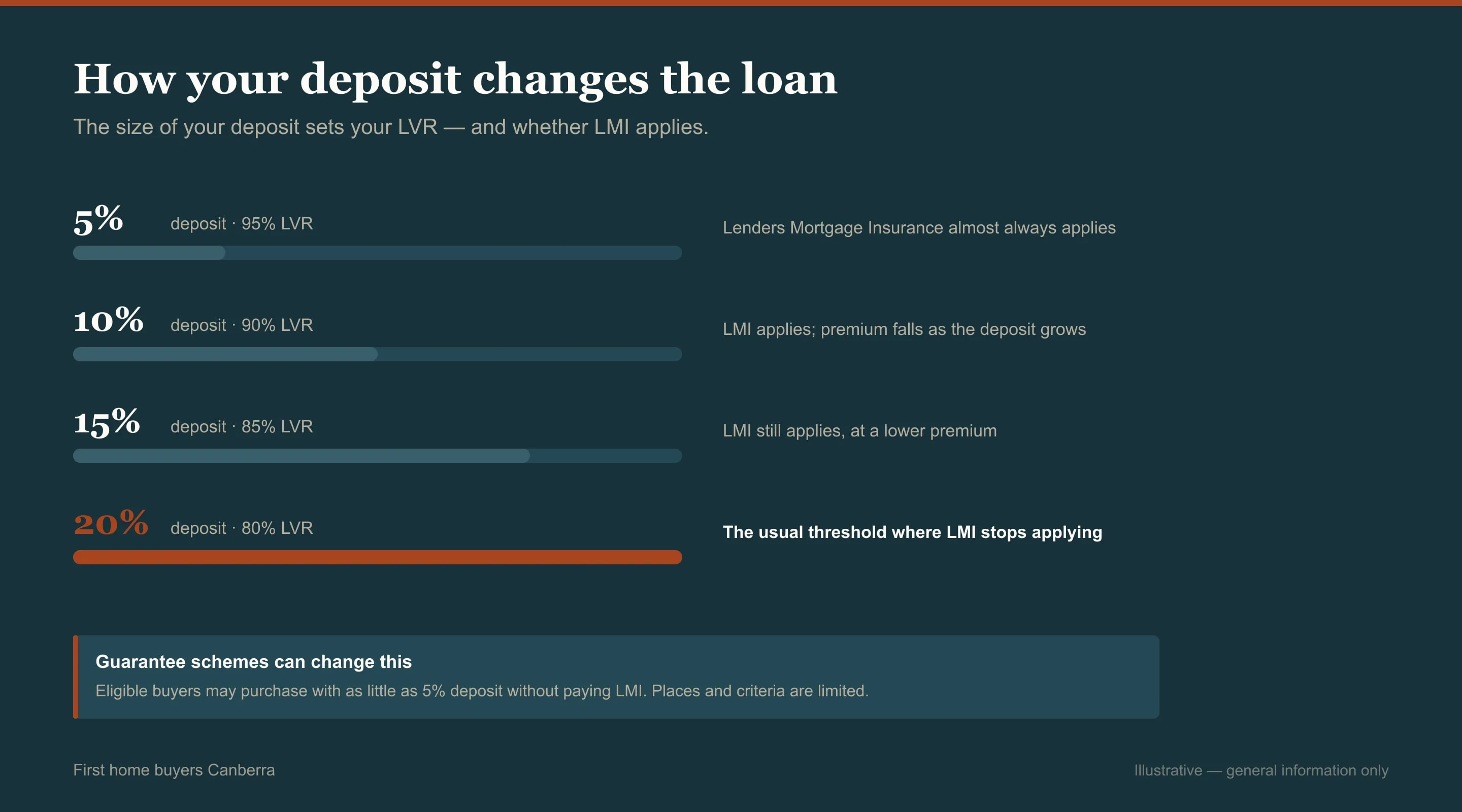
Five per cent through the federal deposit scheme if you are eligible and the Canberra property is under the cap. Otherwise most lenders want five to ten per cent as a minimum with LMI charged, and twenty per cent to avoid it. A family guarantee can reduce what you need further again. We work out which of those is open to you before you set a savings target.
What does it cost me to have you check my eligibility?
Nothing. We are paid by the lender that ultimately writes your loan, not by you, and what we are paid is disclosed in writing before you commit to anything. There is no charge for the eligibility conversation, for working through the schemes, or for the application. That holds even if the answer turns out to be that you do not qualify for any of them.
What happens if I turn out not to be eligible?
We tell you plainly, and then we tell you what would change it: usually a date, a deposit figure, or the five-year prior-ownership rule falling away. If a concession is out of reach we work the loan around that instead, using LMI, a guarantee or a longer savings run, and you are under no obligation to proceed. Finding out at this stage costs you nothing; finding out after you have signed a contract is expensive.
Check Which Schemes You Qualify For
Tell us your contract timing, your income and whether you have ever held property anywhere in Australia, and we will work out which concessions and schemes are actually live for you, what the 1 July 2026 change is worth in your case, and the deposit you genuinely need. We do this for buyers across Canberra and the border towns. It costs nothing, and no credit enquiry is made.
Ask about first home buyer
Nothing here touches your credit file.