SMSF Loans Canberra
We arrange the limited recourse borrowing your Canberra fund needs to buy property: checking it services, confirming the holding trust is in place before exchange, and lodging with a lender still active in this space. It costs you nothing, and getting the sequence right is the part that is expensive to fix later.
20 to 30% deposit, plus a buffer
What a fund typically needs before a lender will look at it, with cash left in the fund afterwards. SMSF lending sits well outside standard residential policy.
Lender policy, current at August 2026
What We Arrange For A Fund
We arrange the limited recourse borrowing arrangement. That means checking the fund can support the loan, confirming the holding trust is in place, and lodging with one of the lenders still active in this space.
Our scope is worth stating plainly to you. Whether an SMSF suits you at all, and whether buying property inside super is a sound strategy for your circumstances, are questions for a licensed financial adviser and your accountant. We give no financial or superannuation advice and we will not recommend that you establish a fund. Once you and your adviser have taken those decisions, we arrange the borrowing.
The Structure We Have To Put In Place
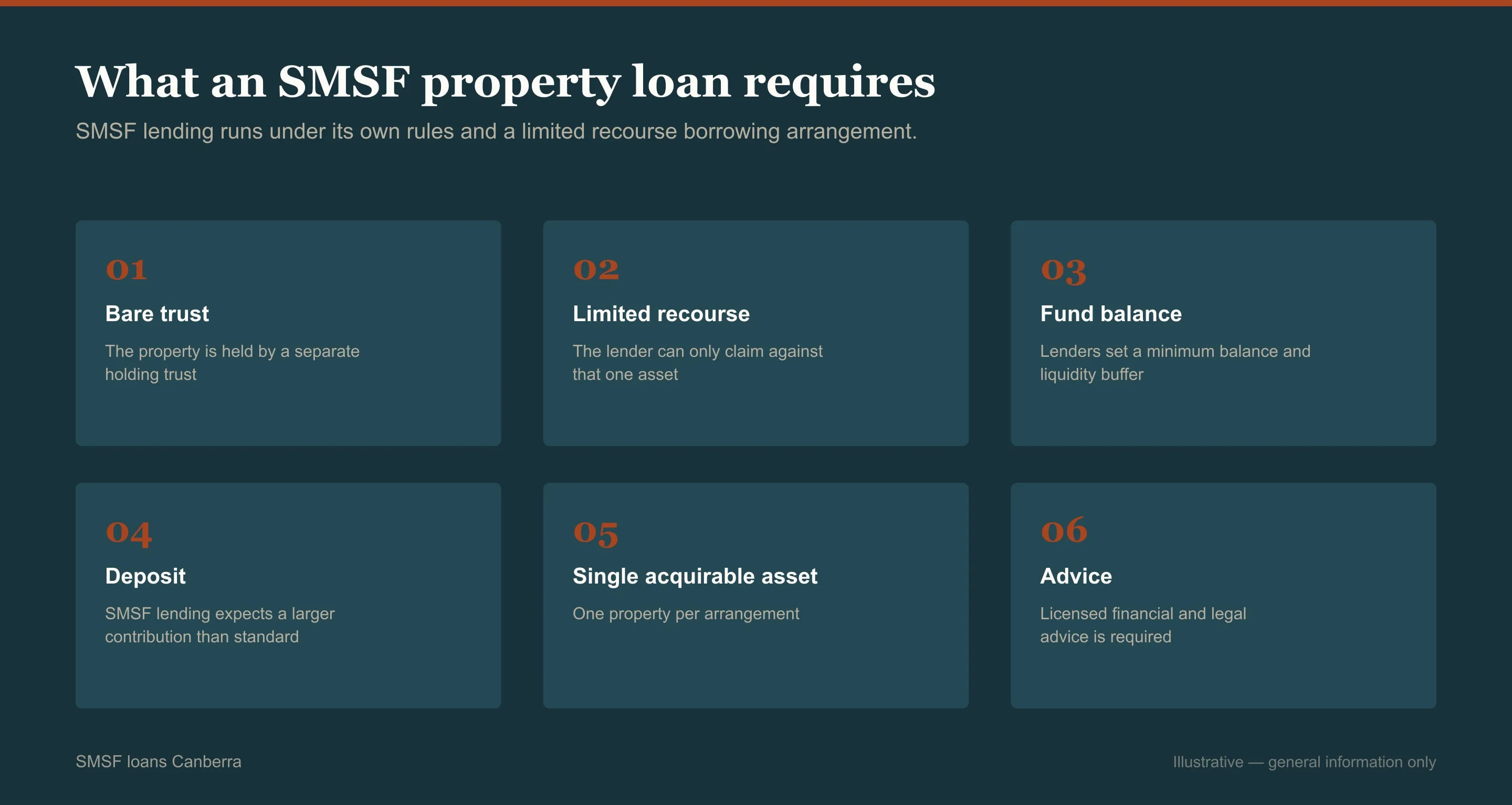
If your fund is borrowing to buy property, a limited recourse borrowing arrangement is the only way it can be done. The structure is prescribed rather than optional, so this is not something we can simplify for you or for any other Canberra trustee. We can only make sure it is set up correctly.
Your property is held in a separate holding trust, usually called a bare trust, with your fund as beneficial owner. The fund makes the repayments and receives the rent, while legal title sits in the holding trust until the loan is repaid.
The limited recourse part is what protects the rest of your fund: if the loan defaults the lender can take the property in the holding trust and nothing else, and the fund’s other assets are out of reach. That protection is also why lenders price and structure these loans conservatively and why the panel we can approach for you is small. Several major banks withdrew from SMSF lending years ago, leaving mostly non-major and specialist lenders. Knowing which of them are currently writing this business is a large part of what we bring.
One acquirable asset per arrangement is the rule, so if you intend to buy two Canberra properties we are setting up two arrangements, two holding trusts and two loans. We would rather you knew that before you plan the second purchase.
What Your Fund Needs Before A Canberra Lender Will Look At It
Expect your fund to need materially more deposit than you would for a personal purchase. Twenty to thirty per cent of the property value is the usual range, and some lenders want more depending on the property type. We size that against the specific property you are considering rather than the general rule.
Liquidity is the requirement trustees most often underestimate, so we check it early. Lenders want cash left in your fund after settlement rather than a fund emptied into the deposit, because the fund still has to meet repayments if the property sits vacant, still has to pay its running costs, and may have pension obligations. A fund with no buffer fails that test however strong the rent looks, and it is better to hear that from us before you exchange.
The lender assesses servicing on your fund, not on you. Contributions and rent are the income it counts, and your personal salary does not enter into it. So where your contributions sit near the concessional limits there is little headroom, and that is usually what constrains the purchase rather than the deposit. We work that figure out before you look at a single Canberra listing, because it sets what the fund can realistically buy.
What Your Fund Cannot Do With The Property
Your fund can maintain and repair a property held under a borrowing arrangement, but it cannot borrow to improve or develop it. That distinction gets misunderstood constantly and it is not a technicality. Breaching it puts your fund’s compliance status at risk, so we raise it at the start rather than when you ring us about a renovation.
Repairing a roof on your Canberra property restores the asset and is fine. Adding a second storey, subdividing or developing the block turns the asset into something different, and super law does not permit your fund to do that with borrowed money while the arrangement is in place. Improvements your fund pays for out of its own cash sit under different rules again, and the line between a repair and an improvement is finer than it looks.
So before you plan any work on a property held this way, have your accountant or SMSF adviser confirm the position against the specific facts. It is a compliance question rather than a lending one, and we will tell you when you have crossed from one to the other rather than guessing at an answer that is not ours to give.
Which Kind Of Property You Are Buying
Both are possible and they behave quite differently, so tell us which you are looking at before we approach anyone.
Residential
Straightforward to value and easy to let, but one hard rule governs it: neither you nor any related party may live in it or rent it, at any time, at any rent. It has to be held purely at arm’s length as an investment. That rule is absolute, breaching it is a serious compliance problem for your fund, and we will make sure you have heard it plainly before the application goes anywhere.
Commercial
Super law treats business real property differently. Your fund may acquire it from a related party and lease it back to a related business, provided the arrangement is genuinely at market rates and properly documented. That is why this structure appeals if you own a Canberra business and want your fund to hold your premises. We arrange the lending on commercial terms. The compliance requirements are exacting, so have your accountant structure it before we start the loan application rather than alongside it.
What We Check Before Approaching A Lender
The lender assesses your fund rather than you personally, and these are the points we work through with you first.
- Deposit and post-settlement liquidity
- Twenty to thirty per cent commonly, with cash retained in the fund afterwards. The buffer requirement is not negotiable with most lenders.
- Fund income
- Contributions plus rent. Where contributions are near the concessional caps, headroom is limited and that usually binds before the deposit does.
- Structure and documentation
- Holding trust properly established, trust deed permitting the borrowing, and the arrangement documented correctly before settlement.
- The lender panel
- Small. Most major banks left this space, so the comparison is between non-major and specialist lenders with tighter policies.
- Property type
- Standard residential and business real property are the workable cases. Unusual security is very difficult inside a fund.
How We Put Your Canberra SMSF Purchase Together
The structure has to be right before the loan is lodged. Getting the order wrong on a Canberra purchase is expensive to unwind.
-
Confirm the fund and the advice
Trust deed, current financials, contribution history and cash position. Your accountant or adviser confirms the strategy is appropriate first.
-
Serviceability on the fund
Contributions plus expected rent against the proposed loan. This is where most proposals are sized.
-
Holding trust established
Your adviser establishes the bare trust and its trustee before you exchange, not after. The sequence matters and lenders check it, so we make sure you have done it in the right order.
-
Lender selection and application
From the small active panel, matched to the property type and the fund’s position.
-
Valuation and settlement
Settlement is into the holding trust. Your accountant confirms the fund’s records reflect the arrangement correctly.
Worth having to hand: the trust deed, the latest fund financials, two years of contribution history and the fund’s current cash position. Have your adviser’s confirmation that the purchase suits the fund’s strategy as well, because no lender will move without it.
SMSF Loans Questions
Can my SMSF borrow to buy property?
Yes, through a limited recourse borrowing arrangement. The property is held in a separate holding trust with the fund as beneficial owner, and the lender’s recourse on default is limited to that property alone. Whether it suits your circumstances is a question for a licensed financial adviser rather than a mortgage broker.
How much deposit does a fund need?
Commonly twenty to thirty per cent of what the Canberra property is worth, with more required for some property types. Just as important is the cash the fund keeps after settlement. Lenders want a liquidity buffer left in the fund, and a fund emptied into the deposit will not be approved however good the rent looks.
What is an LRBA?
A limited recourse borrowing arrangement, the structure super law requires when a fund borrows to buy an asset. A holding trust owns the legal title while the fund holds the beneficial interest and makes the repayments. The lender can only pursue that single asset if the loan defaults. One acquirable asset per arrangement.
Can the fund borrow to develop or improve the property?
No. A fund can maintain and repair a property held under one of these arrangements, but it cannot use borrowed money to improve or develop it. Replacing a roof is a repair; adding a storey or subdividing is not. Confirm any planned work with your accountant or SMSF adviser first, because getting it wrong is a compliance problem for the fund.
Can I live in a property my SMSF owns?
No, and neither can any related party, at any rent. A Canberra residential property held by your fund must be at arm’s length for investment purposes only. Business real property is treated differently and can in some circumstances be leased to a related business at market rates, but have your accountant structure that before you proceed and we will arrange the lending around it.
What do you charge a fund for arranging the loan?
Nothing. The lender that writes the loan pays us, and what we are paid is disclosed to you in writing before you proceed. That includes assessing whether your fund services the borrowing at all. If it does not, you have paid nothing to find that out before committing to a property.
What do you need from the fund to get started?
The trust deed, the current financials, the contribution history and the fund’s cash position, plus confirmation from your adviser or accountant that the strategy is appropriate. Those tell us what the fund can borrow and what deposit and liquidity buffer a lender will want. Work through it before you exchange, because the holding trust has to be established beforehand.
Get The Structure Right Before You Buy
Once your adviser has confirmed the strategy, the trust deed, the latest financials and the fund’s cash position tell us what your fund can actually borrow. From there we can set out the deposit and post-settlement liquidity a lender will require, which of the remaining SMSF lenders suit the property, and what has to be in place before you exchange. Trustees across Canberra can have that assessed at no cost, before committing to a property.
Ask about smsf loans
Nothing here touches your credit file.