Home Loans Canberra
We compare lenders against your income and the property you want, tell you what you can realistically borrow, and take the application through to settlement. It costs you nothing. The lender that writes the loan pays us, and we disclose what we are paid before you commit.
3 percentage points
Added to the loan rate before a lender decides whether you can afford the repayments. Every application is tested at the higher figure, not the rate you pay.
APRA, buffer held 23 July 2025
What We Do On Your Application
We compare lenders against your income, your deposit and the property you want, then prepare and lodge the application and manage it to settlement. That covers a purchase, an upgrade, or a first loan on a block you already own.
It also covers the checks that stop a Canberra application before it starts. We pull the remaining term on your Crown lease, confirm the property type is one your chosen lender will accept, and read your credit conduct the way an assessor will. A decline leaves a mark on your file whether or not the application ever had a chance, and avoiding one is worth more to you than shaving a few points off a rate.
How Much You Can Borrow In Canberra
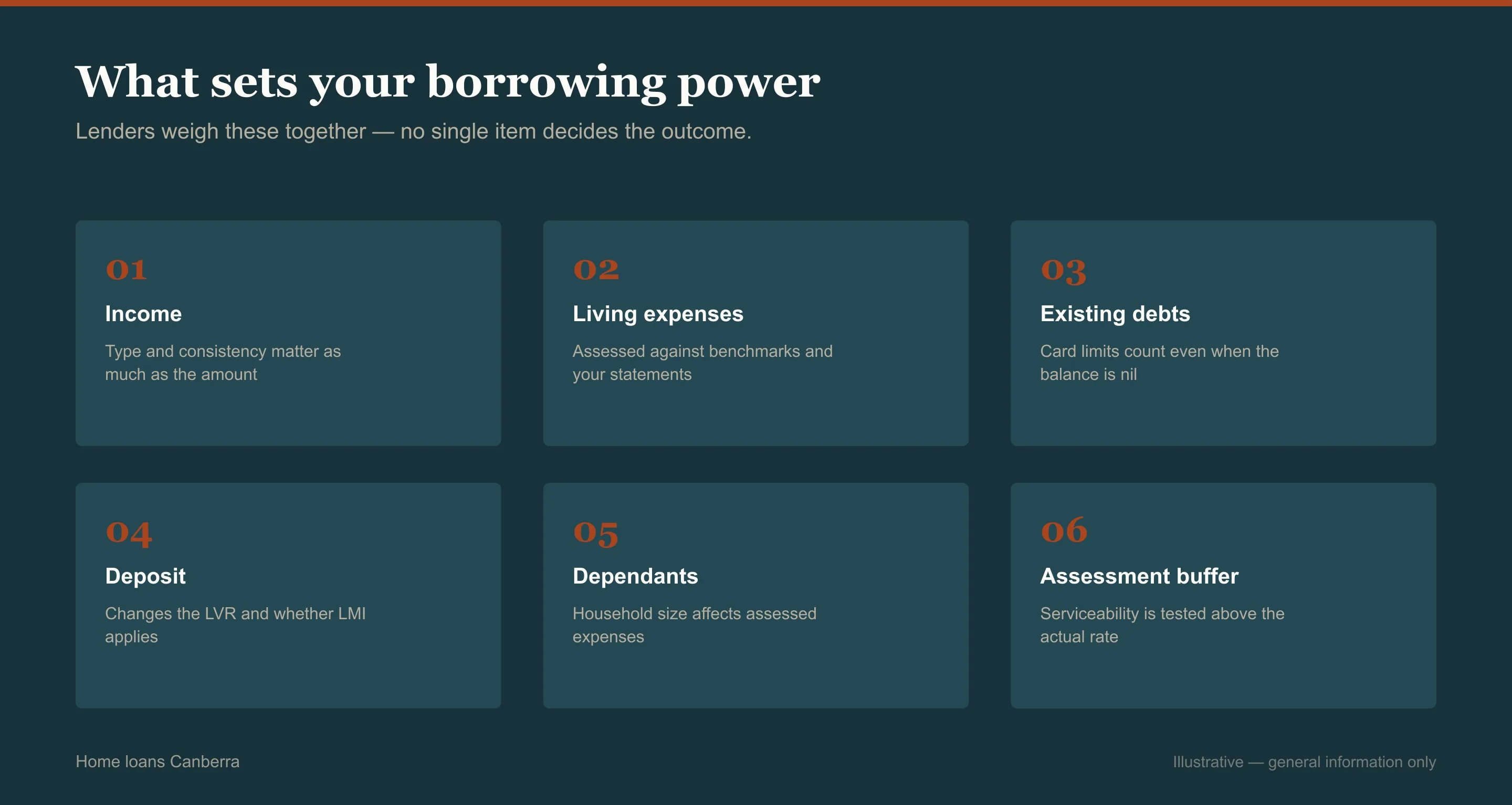
Your borrowing figure is not calculated on the rate you will pay. Every lender must test you at least three percentage points above the product rate. APRA set that buffer in October 2021 and confirmed on 23 July 2025 that it stays, so your capacity is worked out against repayments you are not actually making. We run your numbers at the buffer from the start, which is why the range we give you holds up when the lender does its own assessment.
Two other rules cost you more than you would expect. The lender floors your declared living expenses at the Household Expenditure Measure benchmark, so trimming what you write down gains you nothing. And it assesses every credit card on a notional repayment against its full limit rather than its balance, so a card sitting at zero with a large limit is still eating into what you can borrow. We look at your limits before anything is lodged and tell you which ones to close or reduce first. For most Canberra applicants that is the fastest gain available, and it has to happen before the application, not after.
How We Check Your Crown Lease
Your Canberra block, a unit site included, is held on a 99-year Crown lease under Torrens title at a nominal dollar a year. It is not a lesser form of ownership. You buy, sell, mortgage and pass it on exactly as you would freehold, lenders across the country write against it daily, and it will not by itself cost you a lender.
What can cost you one is the term remaining, so we pull it from the title early. The earliest residential leases began falling due in 2023 and the ACT Government expects roughly a hundred and fifty more across the coming decade. Where the remaining term is short a lender will generally require you to apply for a further Crown lease before your settlement or refinance can complete, and that is not something to discover three days out. We would rather find it while there is time to start the application.
The Lease Variation Charge is a separate thing and will not catch you buying an ordinary Canberra home. It applies where a lease is actually varied: subdividing, redeveloping, or unit-titling a block. If you are buying a house to live in, nothing about your lease is being varied, and we will say so rather than leave you wondering.
How We Structure The Loan With You
Two structural choices come up on nearly every Canberra application. Neither has a universally correct answer, so we settle each one by asking you something specific rather than defaulting.
Fixed or variable
Fixing buys you certainty and costs you flexibility: fixed loans generally cap or bar extra repayments, an offset often will not apply during the fixed term, and breaking early triggers a cost calculated on the lender’s funding position rather than a set fee, so it cannot be quoted in advance. What we ask you is whether you expect to sell, renovate or come into a lump sum inside the fixed term. If you do, we will not fix the whole loan. We split it, so the certainty covers the part you are definitely keeping.
Offset or redraw
An offset is a separate transaction account whose balance reduces the interest you are charged. Redraw is money you have already repaid and can pull back. The difference matters if this Canberra property might later become an investment, because money taken back out of redraw can change the tax character of the debt in a way offset funds do not. Your accountant confirms the tax position, but tell us early if the property might be rented out one day. We structure the loan around that answer, and it is far cheaper to set up correctly than to unwind later.
What We Look At Before Choosing A Lender
We publish no prices here, because we do not set them. These are the things we weigh on your file, each of which moves the answer up or down.
- Your deposit
- The single biggest lever we have. Lenders Mortgage Insurance generally starts above 80% of the property value and is a one-off premium protecting the lender rather than you, so where you sit close to that line we will show you what crossing back under it changes: both the cost and which lenders will look at you.
- How you are employed
- Ongoing salaried work is the straightforward case. Contract, casual, labour-hire and self-employed income are each read differently and the spread between lenders is wide, so we match your engagement to the lenders that read it best rather than the one you bank with.
- Your credit conduct and recent enquiries
- Missed payments count against you, and so does a cluster of recent enquiries. Several applications in a short window reads as distress whatever the reason was. We check this before lodging so we are not adding another mark to a file that cannot carry one.
- The property you have chosen
- A standard house on a standard Canberra block is the easy case. Small units, high-density buildings, rural-zoned land and unusual construction each narrow the list, so send us the listing and we will tell you which lenders remain before you offer.
- What you are borrowing for
- Owner-occupier and investment loans are priced and assessed differently, and changing a loan’s purpose later carries consequences. We ask what you intend at the start so the structure suits the plan rather than just the purchase.
How We Compare Lenders For Home Loans Canberra Buyers Use
Rate is the obvious comparison and rarely the deciding one for you. The same application produces different borrowing limits at different lenders, because each reads your overtime, allowances, rental income, HECS debt and card limits under its own policy. That is why we put your figures through several before recommending anything.
What you get back is a shortlist with the reasoning attached to each name. Under the Best Interests Duty, in force since 1 January 2021, that reasoning has to serve you rather than us, and where cost and convenience conflict ASIC expects cost to be given priority. If the lender that suits you best is the one already holding your accounts, that is what we will tell you.
What Happens After You Get In Touch
Six steps, and they run the same way for every Canberra application. The parts that stall are almost always documents, so the second step is the one to move quickly on.
-
Call us or use the form
Twenty minutes on income, debts, deposit and timing. No credit check, no obligation.
-
Documents in
Two recent payslips, three months of transaction statements, and the limit on every credit card and personal loan. This is the step that sets how fast the rest moves.
-
Capacity across several lenders
Your figures go through multiple policies. You get a realistic range, not a single optimistic number.
-
Shortlist and recommendation
A short list with the reasoning for each, and one recommendation.
-
Pre-approval lodged
Typically a few business days. Now you know your ceiling before you bid.
-
Contract, valuation, formal approval, settlement
The lender values the property and confirms the lease term. Your conveyancer handles settlement. Conveyance duty falls due after title registration, not on the day.
Worth having to hand before the first call: your photo ID, your payslips, your card limits, and if a Canberra property is already in play, the contract or the listing with the Crown lease details for the block. The remaining lease term is the first thing a lender checks on an ACT title.
Home Loans Questions
How much can I borrow?
It depends far more on lender policy than on your salary. Every lender must assess you at three percentage points above the product rate, floor your living expenses at the Household Expenditure Measure benchmark, and count your full credit card limits rather than balances. The same income can produce a materially different answer at two lenders, which is why we run every Canberra file through several before quoting you a range.
Does the ACT Crown lease affect my loan?
Not in the ordinary case. Leasehold title is standard across Canberra and lenders treat it as normal security. What gets checked is the years remaining on the lease. If the term is short, the lender will usually want a further Crown lease applied for before settlement or refinance completes.
What deposit do I need to avoid LMI?
Generally 20% of the property value, since Lenders Mortgage Insurance is usually triggered above 80%. There are two common ways around it without waiting: a family guarantee, or a professional waiver if your occupation qualifies with that particular lender. Both have their own pages on this site.
Should I get pre-approval before I start looking?
Yes, in almost every case. Pre-approval tells you your ceiling and makes an offer credible to a Canberra agent. It also surfaces problems while there is still time to fix them, rather than after you have signed a contract.
How long does approval take?
Pre-approval is commonly a few business days once your documents are with us, longer if your income is complex or the lender is running behind. Formal approval after you have a contract depends on the valuation. From contract to settlement is usually four to six weeks, set by the contract rather than by the lender.
What do you charge me?
Nothing. The lender that writes your loan pays us an upfront commission and an ongoing trail, and both are disclosed to you in writing before you proceed. There is no fee for the first conversation, for working out your borrowing capacity, or for the application itself, and we are bound by the Best Interests Duty regardless of what any particular lender pays.
What do you need from me to get started?
Two recent payslips, three months of transaction statements, and the limit on every credit card and personal loan. If you have a property in mind, the listing helps too. That is enough to work out a borrowing range and a shortlist of lenders. Nothing is lodged and no credit enquiry is made at that stage.
Get Your Borrowing Power Checked
Before you bid on anything, let us tell you what a lender will actually support. From your payslips, statements and card limits we work out a borrowing range assessed at the buffer, a shortlist of the lenders whose policy fits your income, and a plain answer on whether the property type and the Crown lease term will finance. We cover Canberra and the border towns, it costs you nothing, and nothing touches your credit file until you tell us to proceed.
Ask about home loans
Nothing here touches your credit file.